Why early bearing faults are difficult to detect wirelessly
Maintenance teams have a fundamental objective: identify developing faults early enough to plan intervention before unplanned downtime occurs. In many rotating assets, such as pumps, motors and fans, early bearing faults can generate short-duration, high-frequency vibration signatures that appear long before conventional vibration indicators begin to rise.
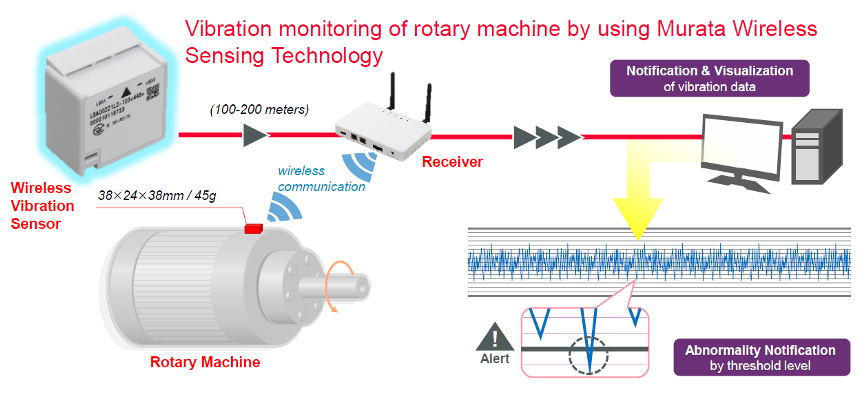
Murata’s approach starts with the sensing element. The LBAC0ZZ2TF wireless vibration sensor uses its own piezoelectric sensing technology to measure acceleration frequencies up to 10 kHz. (Figure 1).
Reliable wireless communication matters in harsh environments
High-frequency sensing is only one part of the challenge. A wireless vibration sensor also has to communicate reliably in industrial environments where metal structures, long distances, moisture, vibration and restricted access can all affect deployment.
Murata’s Wireless Vibration Sensor System uses its proprietary sub-1GHz wireless communication designed for stable operation in demanding environments. The network supports line-of-sight communication distances of approximately 100–200 m and can support more than 1,000 sensors per gateway at hourly transmission intervals, without repeaters. This helps support condition monitoring on equipment where installing signal cabling would be difficult, expensive or impractical.
Rather than continuously transmitting raw vibration waveforms, the system processes data locally and reports machine-health indicators such as acceleration RMS, velocity RMS, spectral peaks, kurtosis and temperature. This helps reduce communication overhead while preserving the information maintenance teams need to identify developing faults.
Underground mining environments are a good example where robust communication is key. Here, thick rock walls, long transmission distances, moisture and limited infrastructure can make connectivity difficult. In a UK underground mine, Murata’s wireless vibration sensors maintained communication with the gateway located on the opposite side of a thick stone wall, allowing continuous monitoring of a critical ventilation fan despite the harsh operating environment.
Slow-speed equipment needs a longer observation window
Low-speed machinery presents another monitoring challenge. When rotational speeds are low, fault-related vibration events are spaced further apart in time because they typically occur once per rotation. A short sampling window may simply miss them.
Some systems attempt to solve this by extending measurement time while reducing sampling frequency. That can increase the likelihood of observing an event, but it may also filter out the high-frequency content associated with early-bearing damage.
Murata addresses this limitation by allowing the maintenance team to extend the observation window from 0.2 s to 5 s while maintaining a 40.96 kHz sampling rate.
Slow-speed equipment needs a longer observation window
Murata’s Wireless Vibration Sensor System combines piezo-based high-frequency measurement, intelligent edge processing and robust sub-1GHz wireless communication in a compact, easy-to-install device that can operate for up to five years under typical conditions. Collectively, these capabilities help maintenance teams identify developing faults earlier and apply predictive maintenance across a wider range of rotating equipment.
Some systems attempt to solve this by extending measurement time while reducing sampling frequency. That can increase the likelihood of observing an event, but it may also filter out the high-frequency content associated with early-bearing damage.
Murata addresses this limitation by allowing the maintenance team to extend the observation window from 0.2 s to 5 s while maintaining a 40.96 kHz sampling rate.
Small size makes vibration measurement harder
Wireless vibration sensors are often deployed on equipment that was never designed to accommodate permanent monitoring. High-frequency sensing is valuable only if it can be applied in the field without turning installation into a specialist engineering project.
Murata’s magnet-mounted sensor measures 38 × 24 × 38 mm and weighs approximately 45 g, allowing it to be mounted directly onto a wide range of rotating equipment. Achieving reliable vibration measurement in a device of this size is not straightforward. High-frequency measurement places strict demands on sensor placement, housing stiffness and mechanical coupling to the machine surface. Unwanted resonances or damping within the enclosure can distort the vibration signal, particularly at higher frequencies.
The quarry pump that gave a month’s warning
A quarry water pump provides a useful example. The system was piloted on a pump supplying water from a tower to critical cutting equipment.
Murata’s magnet-mounted sensor measures 38 × 24 × 38 mm and weighs approximately 45 g, allowing it to be mounted directly onto a wide range of rotating equipment. Achieving reliable vibration measurement in a device of this size is not straightforward. High-frequency measurement places strict demands on sensor placement, housing stiffness and mechanical coupling to the machine surface. Unwanted resonances or damping within the enclosure can distort the vibration signal, particularly at higher frequencies.
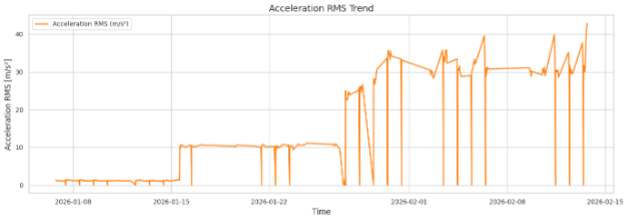
During normal operation, acceleration RMS remained stable at approximately 1.5 m/s². (Figure 2). Around one week later, the value increased to approximately 10 m/s² despite no significant changes in operating conditions. Over the following weeks, vibration levels continued to rise until the pump eventually failed.
Small size makes vibration measurement harder
Murata’s Wireless Vibration Sensor System combines piezo-based high-frequency measurement, intelligent edge processing and robust sub-1GHz wireless communication in a compact, easy-to-install device that can operate for up to five years under typical conditions. Collectively, these capabilities help maintenance teams identify developing faults earlier and apply predictive maintenance across a wider range of rotating equipment.